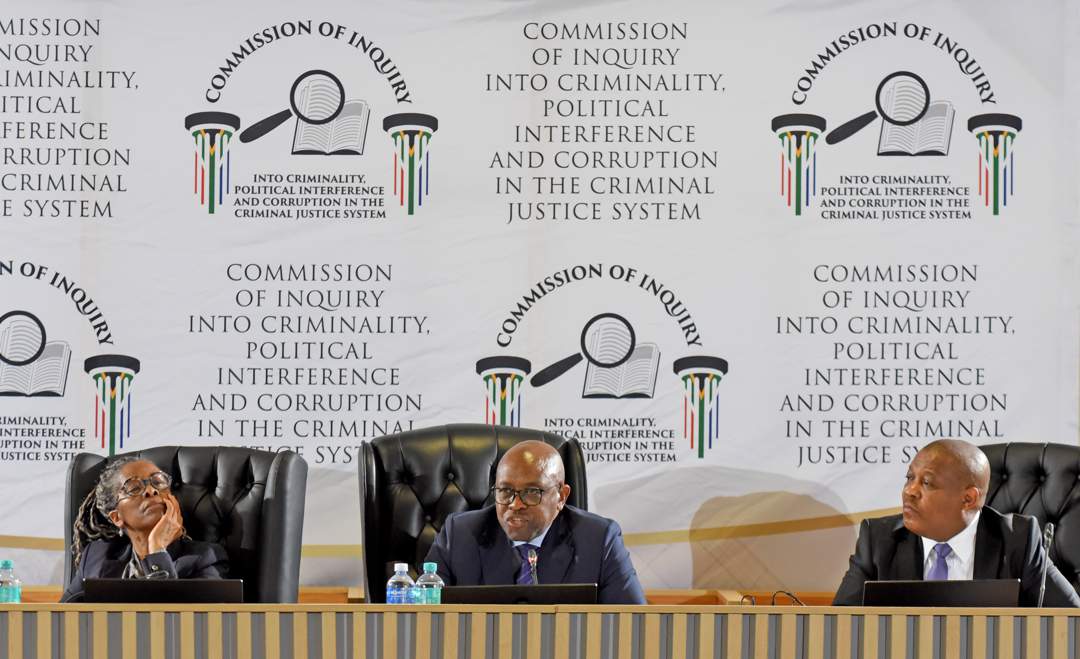
The Madlanga Commission's Critical Role in Unraveling South Africa's Drug Crisis

Editor 30 May, 2026 ... min lectura

South Africa's Madlanga Commission has emerged as a pivotal investigative body in the nation's ongoing battle against drug trafficking and corruption. Formally established to address systemic failures in law enforcement, the commission's recent actions highlight a complex interplay between state security, political influence, and economic pressures.

The commission's second interim report, released in May 2026, focuses on a critical disconnect between intelligence operations and actual on-the-ground enforcement. Key findings reveal that over 150,000 kilograms of cocaine have gone missing from major seizures since 2021, raising urgent questions about accountability and transparency within national security agencies.

A recent police inquiry into 'gifts' from alleged lovers of high-ranking officials has further complicated the narrative. While some officers have been implicated in 'botched' cocaine raids, the commission's focus has shifted to understanding how these operations intersect with broader corruption networks. This dual focus reflects South Africa's growing concerns about the convergence of drug trafficking, political influence, and economic exploitation.

How do missing drug hauls reveal systemic corruption?

The commission's investigation into missing cocaine hauls has uncovered evidence that suggests a sophisticated network of collusion between intelligence agencies and private entities. One notable case involves Brig Rachel Matjeng, who oversaw a tender awarded to controversial businessman Vusimuzi 'Cat' Matlala in 2024. This case illustrates how public funds can be misused through opaque procurement processes, creating vulnerabilities that enable illicit activities.

  • Over 150,000kg of cocaine reported missing from seized operations since 2021
  • 2024 procurement tender linked to 'Cat' Matlala's alleged involvement in drug trafficking
  • Multiple police officers implicated in 'gifts' from alleged lovers of high-ranking officials

The commission's work demonstrates that missing drug hauls are not merely a matter of poor logistics but a symptom of deeper institutional failures. When high-value assets disappear without trace, it signals potential collusion with private actors who manipulate supply chains and intelligence operations.

As the commission shifts its focus to missing cocaine hauls, it has uncovered a pattern of systemic corruption that connects drug trafficking to broader economic exploitation. The 'gifts' from alleged lovers of officials, for instance, suggest that personal relationships are being weaponized to influence critical decision-making processes. This is particularly concerning in a country where drug trafficking has become increasingly sophisticated and interconnected with political power structures.

South Africa's government must address these issues head-on by strengthening oversight mechanisms and ensuring that intelligence operations are independent from political pressures. Without transparency and accountability, the country's efforts to combat drug trafficking will continue to be undermined by the very systems meant to protect it.