Tonight's Celestial Spectacle: The Moon, Venus, and the Pleiades Align

Editor 19 Apr, 2026 ... min lectura

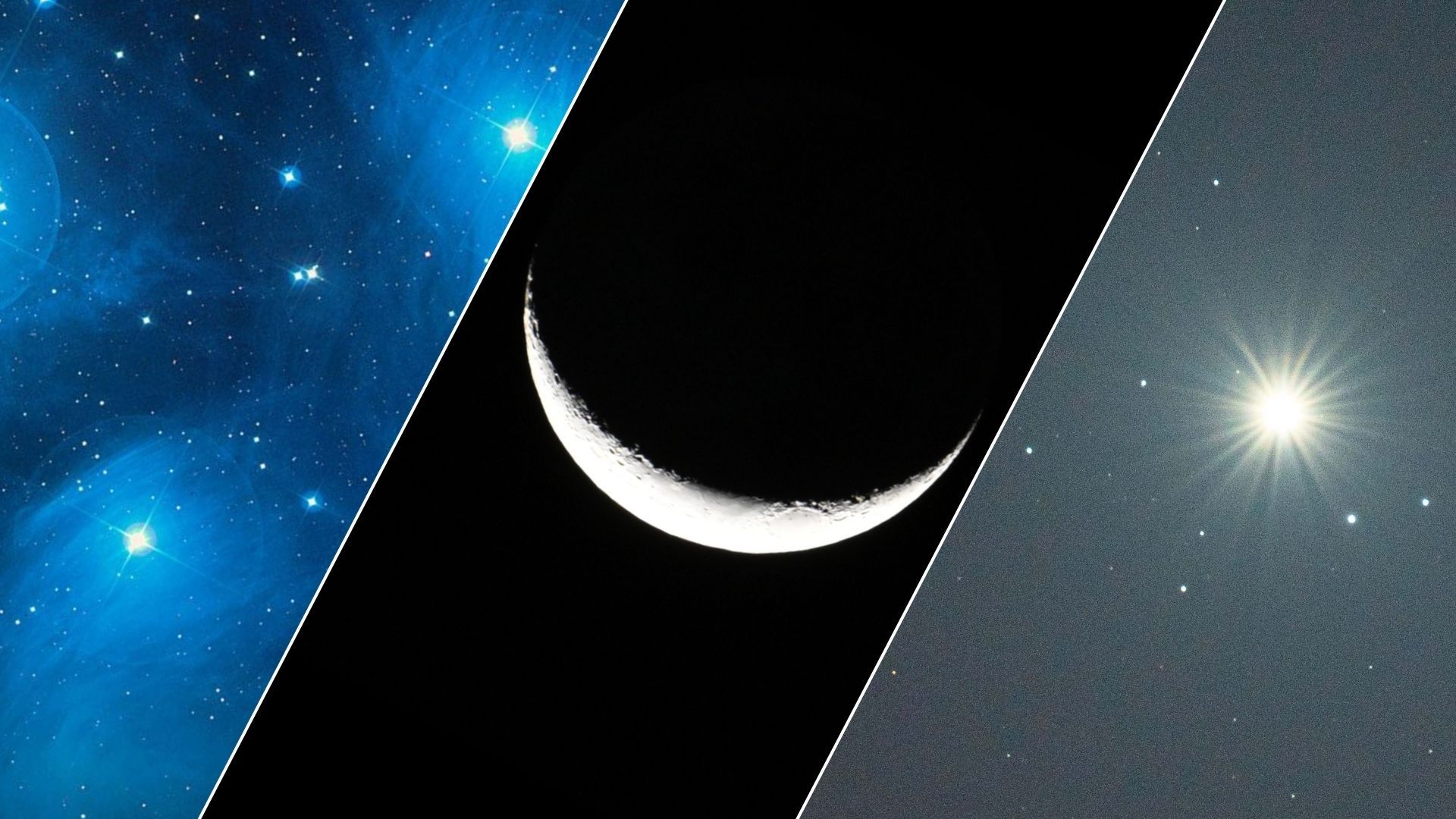
As twilight fades across the globe, an extraordinary astronomical event is set to unfold: the moon, Venus, and the Pleiades star cluster will align after sunset on April 19. This rare alignment offers stargazers a unique opportunity to witness a breathtaking cosmic display that connects ancient mythology with modern astronomy.

The alignment occurs just after sunset, when the crescent moon glows near the bright star Vega in the constellation Lyra, while the brilliant planet Venus shines brightly in the same sky. The Pleiades, a famous open star cluster visible from most parts of the world, will appear as a faint, hazy patch of light near the horizon. This phenomenon creates a striking visual that has captivated humans for millennia, from ancient civilizations mapping the heavens to modern astronomers studying stellar clusters.

Why does this alignment matter?

The moon's position relative to the Pleiades and Venus is not just a visual treat—it has profound implications for understanding our solar system's dynamics. The moon's gravitational pull influences tides, while Venus's orbit around the sun provides insights into planetary motion. The Pleiades cluster, one of the closest stellar associations to Earth, helps scientists trace the evolution of star-forming regions. This alignment allows us to observe these celestial bodies in close proximity, enhancing our understanding of their movements and the mechanics of the solar system.

Historically, cultures worldwide have interpreted such alignments as omens or signs. For example, the Greeks saw the Pleiades as the seven sisters, while the Native Americans associated the Pleiades with the 'Seven Sisters' in their creation myths. Today, this alignment serves as a reminder of humanity's enduring fascination with the night sky and our place in the cosmos.

What makes this event unique?

  • The moon's crescent shape highlights its position in the sky, showing its phase cycle
  • Venus appears as the 'morning star' or 'evening star' depending on its position relative to the sun
  • The Pleiades cluster is visible from most latitudes, making it accessible to a global audience

Unlike other celestial events, this alignment combines the moon's orbital motion with the slow drift of the Pleiades and Venus's elliptical orbit. It's a perfect example of how celestial mechanics shape our night sky.

For stargazers, this event offers more than just a visual spectacle—it's a chance to reflect on the interconnectedness of astronomical phenomena. The moon's gravitational influence on Earth, Venus's role in our solar system, and the Pleiades' role as a star-forming region all highlight the complexity and beauty of the universe.

As we observe this alignment, we also learn about the precision of astronomical measurements. Modern telescopes and software like SkySafari and Stellarium can predict this event with accuracy, allowing even amateur astronomers to locate the objects precisely.