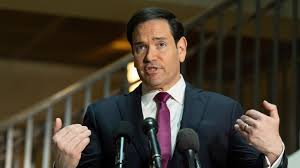
Secretary of State Marco Rubio has made a startling admission regarding the U.S. military posture toward Iran, revealing that American actions in the Middle East are directly influenced by Israeli strategic maneuvers. In a confidential intelligence briefing held at the Capitol Building on March 2, 2026, Rubio acknowledged that Israeli Prime Minister Benjamin Netanyahu's government has effectively constrained the Trump administration's ability to act independently on Iranian threats. This revelation has ignited a fierce debate within the Republican Party, particularly among MAGA supporters who have long divided over the role of Israel in regional conflicts.
Rubio's statement, delivered during a press conference with the Department of State, marked a significant shift in the administration's approach to Middle Eastern security. He emphasized that the Trump administration has been forced to align its policies with Israeli demands, even when such actions contradict U.S. national security interests. 'The Israeli government has created a situation where we have no choice but to respond to their demands,' Rubio said, according to a transcript released by the White House. This admission has raised questions about the extent of U.S. involvement in Israel's military operations against Iran, particularly given the recent escalation of hostilities in the region.
Analysts have noted that Rubio's comments align with a broader trend of increasing tensions between Washington and Tel Aviv. The U.S. has been under pressure to support Israeli military actions against Iran, despite concerns about the potential for wider regional conflict. Rubio's acknowledgment that the U.S. is 'fighting Israel's war' has been met with skepticism by critics who argue that this undermines the principle of U.S. neutrality in Middle Eastern affairs. However, supporters of the administration's strategy argue that it is necessary to protect U.S. interests in the region by ensuring Israeli actions do not escalate into a full-scale war.
Political analysts suggest that Rubio's remarks reflect a growing divide within the Republican Party. While some members of Congress have called for a more assertive stance toward Iran, others are concerned about the potential consequences of prolonged military engagement. The situation has also highlighted the challenges faced by the Trump administration in balancing its foreign policy objectives with the demands of its coalition partners, particularly in the context of the ongoing conflict between Israel and Iran.
As the U.S. continues to navigate this complex geopolitical landscape, Rubio's admission has become a focal point for discussions about the role of U.S. military power in regional conflicts. The implications of his statements could have far-reaching consequences for U.S. foreign policy, especially in light of the recent escalation of hostilities between Israel and Iran. With the world watching closely, the next steps in this crisis will be critical for determining the trajectory of U.S. involvement in the Middle East.