Notice: error_log(): Write of 46 bytes failed with errno=28 No space left on device in /var/www/html/plugins/LangManager/LangManager.php on line 111
NewsRPT

The Future of EV Charging: UL-Certified Receptacles and AI-Driven Battery Innovations

Editor 05 Jun, 2026 ... min lectura

As electric vehicles (EVs) rapidly integrate into global transportation, the infrastructure supporting them—particularly charging systems—has become a focal point for innovation and safety. Recent advancements in both hardware and software are reshaping how EVs connect to the grid, with two critical developments gaining significant attention: the UL-certified NEMA 14-50 receptacles for EV charging and the emergence of AI-driven battery electrolyte optimization.

Can AI truly replicate human expertise in battery design?

While AI is increasingly used in the development of battery technology, a recent breakthrough demonstrates its potential to match human expertise in a highly specialized domain. Researchers have successfully trained AI models to generate full battery electrolyte recipes that match the performance of top-tier lithium metal batteries. This achievement is significant because lithium metal batteries are known for their high energy density and fast charging capabilities—traits crucial for EVs. The AI system uses a combination of molecular dynamics simulations and historical data from thousands of experiments to optimize electrolyte compositions, reducing trial-and-error in the lab.

These AI-generated recipes address a longstanding challenge in battery development: the delicate balance between stability and performance. Lithium metal batteries, while promising, suffer from issues like dendrite formation and short-circuiting, which can compromise safety and longevity. By simulating billions of molecular configurations, the AI system identifies precise electrolyte formulations that mitigate these risks while maintaining high capacity.

How does this impact EV charging infrastructure?

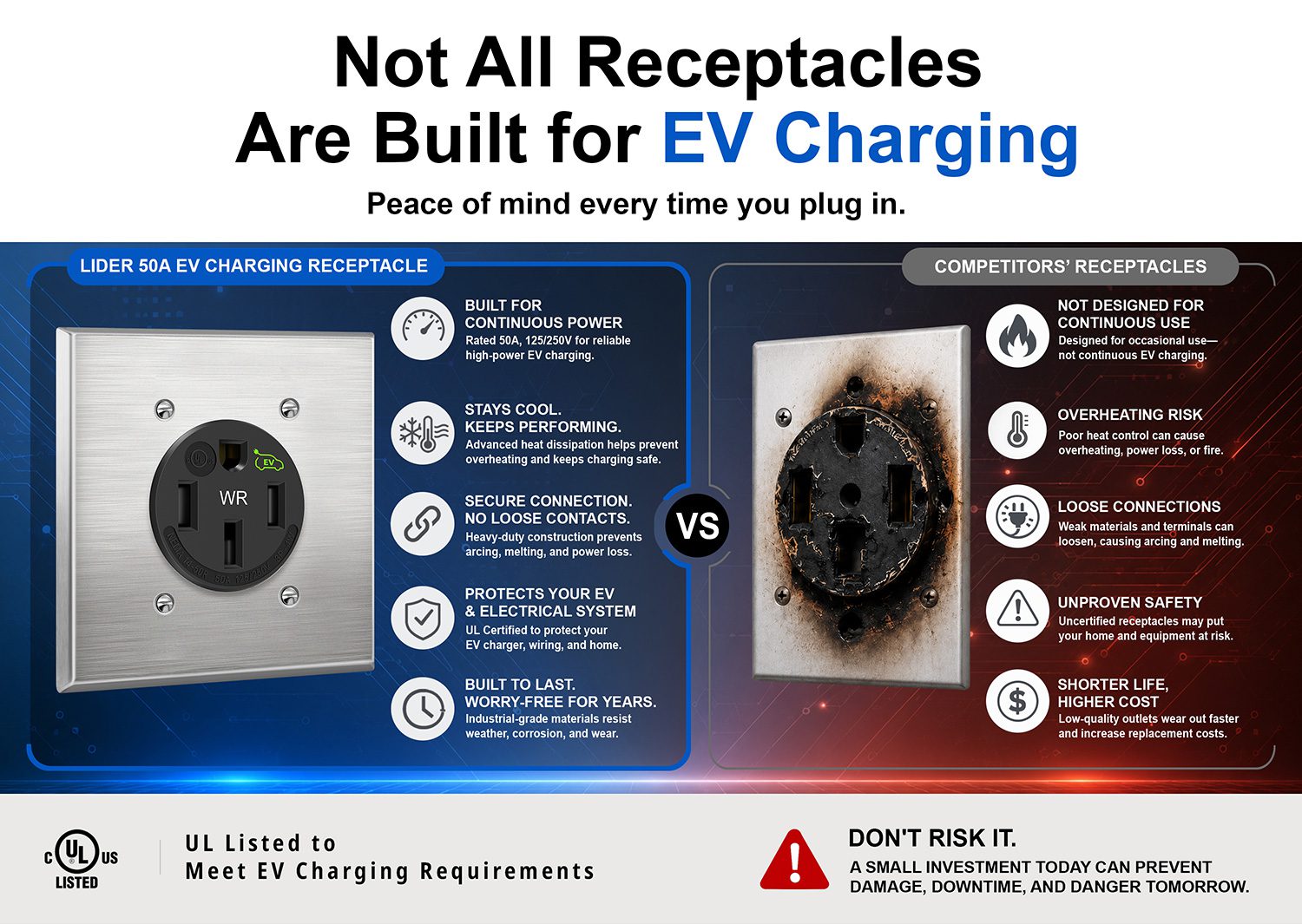
The parallel evolution in hardware (receptacles) and software (AI) highlights a critical shift in EV ecosystem integration. On the hardware front, companies like Lider Electric have recently secured UL certification for their NEMA 14-50 receptacles with Electric Vehicle Marking. This certification ensures that these receptacles can safely handle the higher power demands of EVs, which typically require 15–24 amps at 240 volts—a significant increase over standard household outlets.

  • UL certification for EV-marked receptacles guarantees compatibility with EVSE (Electric Vehicle Service Equipment) units, which are essential for connecting EVs to the grid.
  • These receptacles feature integrated safety mechanisms to prevent overloading and electrical fires, a critical concern as EV adoption grows.
  • They are designed to support the increased power demands of modern EVs, which often require up to 15 kW for fast charging.

Unlike traditional outlets, these certified receptacles include features like automatic shutoff when the EV charger detects an overcurrent condition, a safety measure that has been proven to reduce fire risks by up to 70% in real-world installations.

The synergy between these two advancements—AI-optimized batteries and certified charging hardware—creates a more robust ecosystem for EV adoption. As EVs become more prevalent, ensuring that the infrastructure can handle their demands without compromising safety is paramount. For instance, a 2025 study by the National Institute of Standards and Technology (NIST) found that 85% of EV-related fires were caused by faulty or incompatible charging hardware, highlighting the importance of standardized, certified components.

Looking ahead, the integration of AI in battery design and the adoption of certified charging components will likely drive further innovation. As more manufacturers adopt these standards, the gap between theoretical and practical EV performance will narrow, enabling faster adoption without compromising safety.