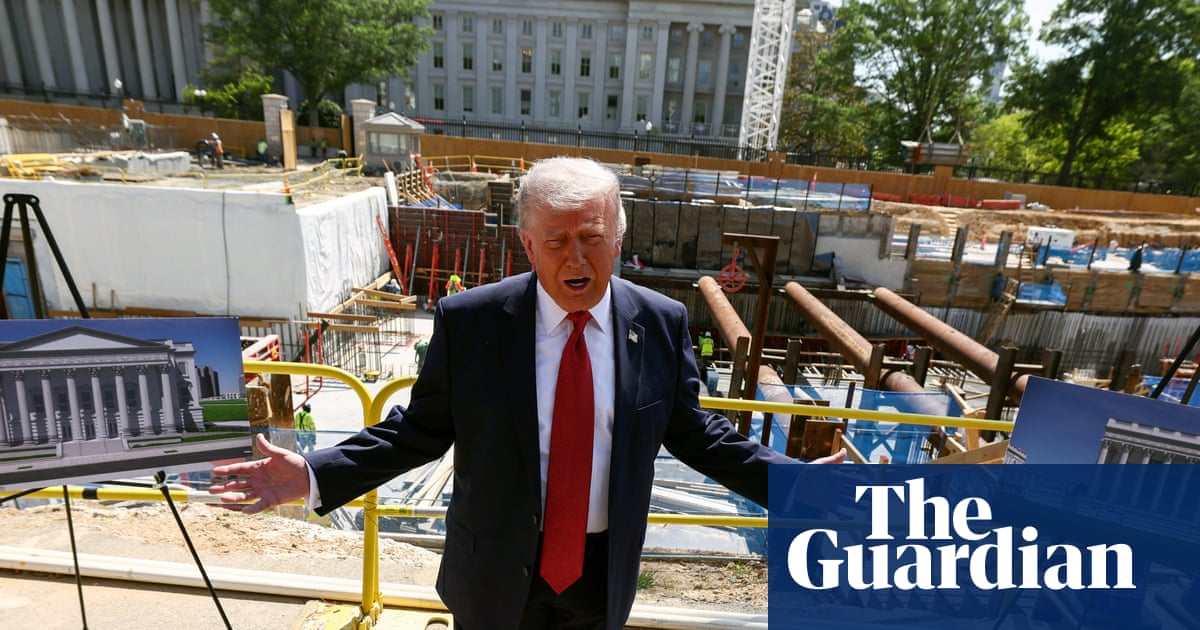
As the legal battle over Donald Trump’s proposed White House Ballroom project intensifies, the intersection of executive power, judicial authority, and national symbolism has become a focal point for constitutional law experts. The case, initially sparked by Trump’s plans to construct a luxury venue within the White House grounds, has now reached the U.S. Court of Appeals, with implications extending far beyond mere architecture.
Can the Courts Block a Presidential Project?
The core dispute centers on whether federal courts can intervene in a project initiated by the President. According to a DOJ lawyer cited in recent developments, no court has the authority to halt Trump’s White House Ballroom initiative. This stance directly challenges the traditional understanding of judicial review, which typically allows courts to overturn executive actions deemed unlawful. The argument hinges on the principle that presidential decisions, once made, fall under the executive branch’s exclusive domain.
The case has drawn comparisons to historical precedents, such as the 1970s-era Supreme Court decisions that clarified the limits of judicial review in cases involving presidential executive orders. However, unlike those cases, this one involves a physical structure—a ballroom—located within the very building that symbolizes American governance. The symbolic weight of the White House grounds makes this a unique case where the law’s application to public property is under scrutiny.
What Does the DOJ Really Want?
- The Department of Justice is advocating for a strict interpretation of the President’s authority to construct on federal land, emphasizing that such decisions are part of the executive branch’s constitutional role.
- Legal experts suggest the DOJ aims to set a precedent that courts must defer to executive branch decisions when they align with the President’s policy goals.
- The defense also highlights the risk of judicial overreach, arguing that allowing courts to block presidential projects could undermine the stability of federal governance.
The DOJ’s position aligns with a broader trend in recent litigation where courts have increasingly respected the executive branch’s role in implementing policy. For instance, in the case of Trump v. Hawaii, the Supreme Court upheld the President’s authority to enforce travel restrictions under executive orders, reinforcing the idea that courts should not second-guess presidential decisions in certain contexts.
However, critics argue that the White House Ballroom case is more complex due to its location on public land. The White House itself is a national symbol, and any construction there could be interpreted as a violation of the federal government’s duty to preserve historical and symbolic integrity. This tension between executive action and public property rights is what makes this case particularly contentious.
Legal analysts note that the outcome could redefine the boundaries of judicial review in cases involving presidential projects. If the courts side with the DOJ, it could signal a shift toward greater deference to presidential actions in matters of national security and public policy. Conversely, a ruling in favor of the plaintiffs might set a precedent that courts can and should challenge presidential decisions that impact public spaces.
The case has also sparked a debate about the role of the judiciary in upholding the principle of separation of powers. Historically, courts have often been the check on presidential overreach, but this case forces a reevaluation of how that balance works when it comes to physical infrastructure on federal property.